LATEST BLOGS
Tuesday, October 13, 2026
Introduction
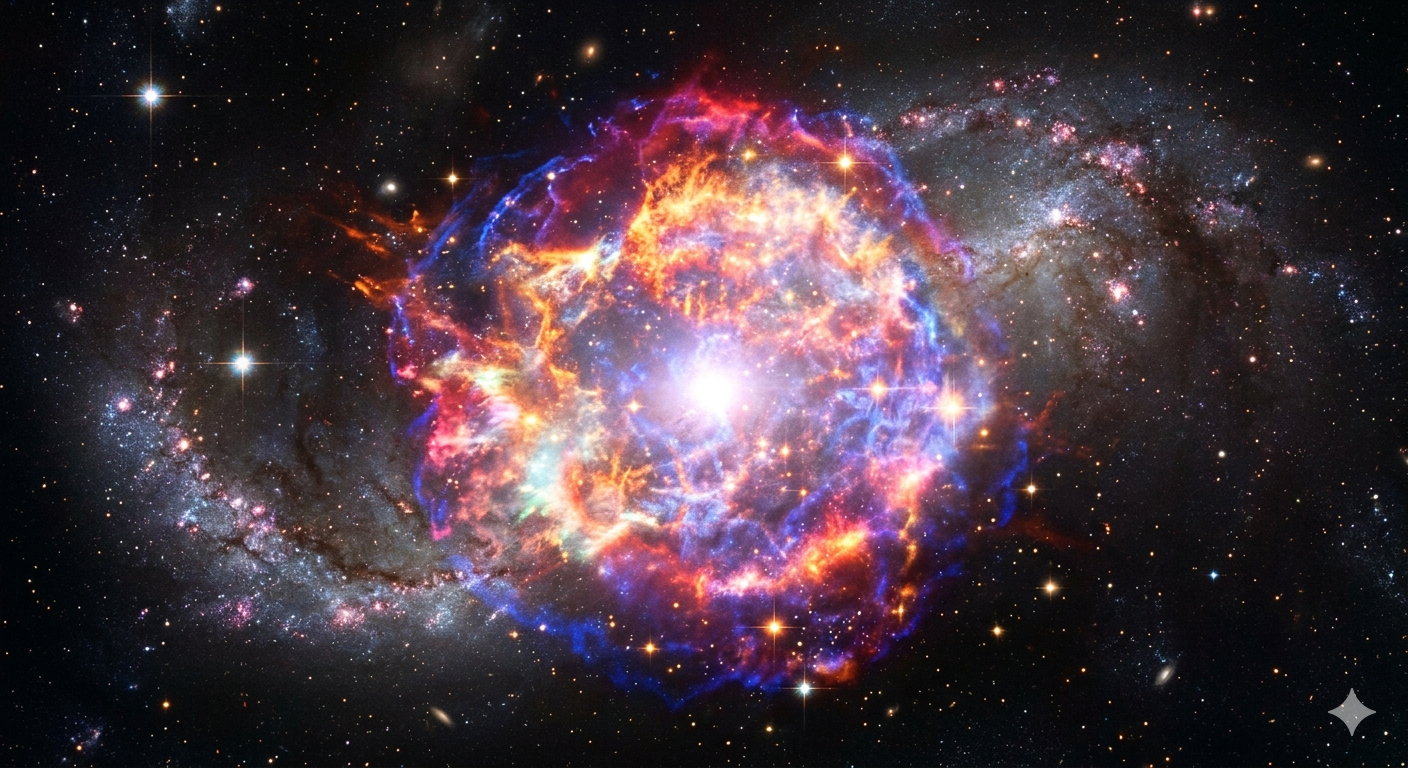
A supernova is one of the most powerful and energetic events in the universe. It marks the violent death of a star, releasing enormous amounts of energy in a short period—sometimes outshining entire galaxies.
Supernovae are not just spectacular cosmic events; they play a crucial role in:
- Creating heavy elements (like iron, gold, uranium)
- Driving galaxy evolution
- Seeding the universe with the building blocks of planets and life
In this blog, we explore the physics, types, and recent groundbreaking discoveries (2025–2026) in supernova research.
What is a Supernova?
A supernova occurs when a star reaches the end of its life and undergoes a catastrophic explosion.
The energy released can be:
\[ E \sim 10^{44} \text{ Joules}\]
This is equivalent to the energy our Sun will emit over its entire lifetime.
Types of Supernovae
Supernovae are broadly classified into two main categories:
1. Type I Supernova (Thermonuclear Explosion)
These...
Tuesday, October 13, 2026
Extended Kalman Filter (EKF): A Step-by-Step Derivation for Nonlinear Systems
Introduction
The Kalman Filter works well for linear systems, but real-world systems are often nonlinear. From spacecraft attitude dynamics to robot localization, nonlinearities are unavoidable.
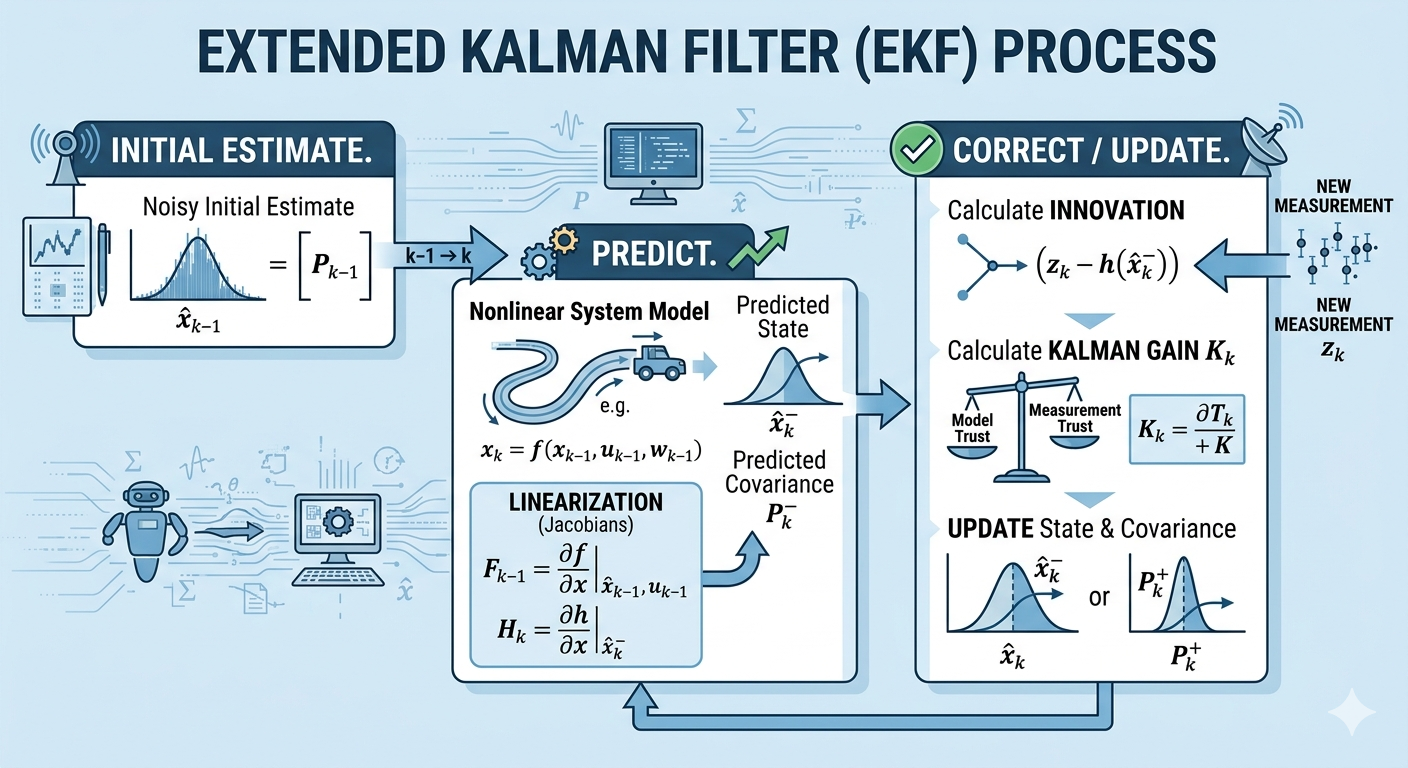
The Extended Kalman Filter (EKF) extends the classical Kalman Filter to handle nonlinear systems by linearizing them around the current estimate.
What is the Extended Kalman Filter?
The EKF is a recursive estimator for nonlinear dynamic systems, where:
- System dynamics are nonlinear
- Measurement models are nonlinear
- Noise is Gaussian
The EKF approximates nonlinear functions using first-order Taylor expansion and then applies Kalman filtering.
Nonlinear System Model
State Transition Model
\[ x_k = f(x_{k-1}, u_k) + w_k\]
Measurement Model
\[ z_k = h(x_k) + v_k\]
Where:
- \(f(\cdot)\) → Nonlinear state transition
- \(h(\cdot)\) → Nonlinear measurement
- \(w_k...
Tuesday, October 13, 2026

Introduction
Vector algebra is a fundamental branch of mathematics that underpins physics, engineering, computer science, and countless other fields. Unlike scalars, which represent magnitude alone (e.g., temperature, mass), vectors encapsulate both magnitude and direction, making them ideal for modeling phenomena like velocity, force, and displacement. This comprehensive guide explores vector algebra in depth, covering foundational operations, advanced concepts, real-world applications, and historical context. With clear explanations and LaTeX-rendered equations, this post is designed for students, professionals, and enthusiasts alike.
1. Foundations of Vector Algebra
1.1 What is a Vector?
A vector is a mathematical entity defined by magnitude and direction, typically represented as an ordered set of numbers (components) in a coordinate system. In 2D space, a vector \(\vec{v}\) is:
\[ \vec{v} = \begin{pmatrix} v_x \\ v_y \end{pmatrix}\]
In 3D space, it extends to:
\[...
FIND MORE
Thursday, May 28, 2026
Introduction
A supernova is one of the most powerful and energetic events in the universe. It marks the violent death of a star, releasing enormous amounts of energy in a short period—sometimes...
Thursday, May 28, 2026
Extended Kalman Filter (EKF): A Step-by-Step Derivation for Nonlinear Systems
Introduction
The Kalman Filter works well for linear systems, but real-world systems are often nonlinear. From spa...
Friday, July 04, 2025
Introduction
Vector algebra is a fundamental branch of mathematics that underpins physics, engineering, computer science, and countless other fields. Unlike scalars, which represent magnitude alon...
Friday, February 14, 2025

Laplace Transformation is a powerful mathematical tool widely used in engineering, physics, and control systems. It simplifies differential equations into algebraic equations, making them easier to...
Thursday, January 16, 2025

Introduction
Exoplanets, or extrasolar planets, are planets that orbit stars outside our solar system. Their discovery has revolutionized our understanding of planetary systems and opened new aven...
Saturday, January 11, 2025

Introduction
In aerospace engineering, thermodynamic cycles are the foundation of engine performance analysis and optimization. One of the most critical cycles in this domain is the Brayton Cycle...
Monday, January 06, 2025

Introduction
Stars, those magnificent celestial bodies that illuminate the cosmos, have finite lifespans. Their evolution is a complex interplay of forces, culminating in a variety of stellar re...
Sunday, January 05, 2025

Introduction
In the realm of aerospace engineering, drag is a critical factor influencing the performance, efficiency, and design of aircraft. Drag is the resistance an aircraft experiences as i...
Sunday, December 29, 2024

CE-20 Cryogenic Engine: A computer model
Space exploration has consistently driven the need for advancements in propulsion technology, enabling humanity to achieve milestones that were once consid...
Thursday, December 26, 2024
Drag and Drag Polar
Drag is a fundamental force encountered in fluid mechanics, opposing the motion of an object moving through a fluid (like air or water). This resistance arises from the interacti...
Thursday, December 26, 2024
Time is more than just a concept—it’s a critical tool for scientific exploration, global communication, and navigation. Different fields require different timekeeping systems, each tailored for specif...
Thursday, December 26, 2024
Stars are born, live, and die in fascinating ways. In this post, we’ll explore the life cycle of a star, from its formation in a nebula to its explosive end as a supernova.